
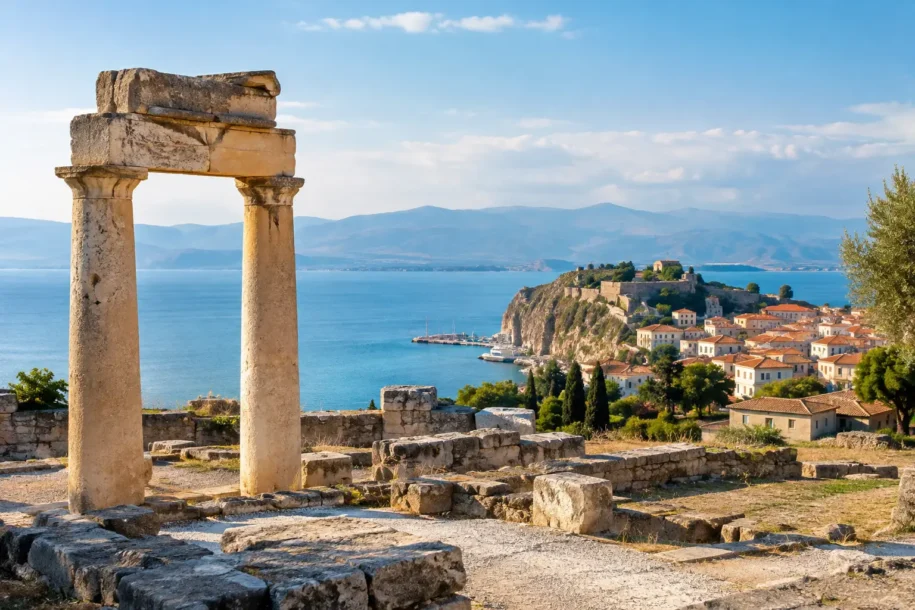
The most memorable days in Argolis begin before the midday heat, when the stone walls are still cool and the olive groves carry the scent of morning. This Nafplio archaeological sites guide is designed for travelers who want more than a quick photo at a famous ruin. It is for those who wish to move through one of Greece’s most remarkable historic landscapes at an unhurried, beautifully considered pace – then return to the coast for a swim, a long lunch, and sunset over the Argolic Gulf.
Nafplio is an exceptional base because antiquity here is not confined to one destination. Mycenaean citadels, an ancient healing sanctuary, classical theaters, and lesser-known coastal ruins all lie within easy reach. The best itinerary depends on how much time you have, the season, and whether you prefer grand monuments or quieter places where history feels almost private.
The essential Nafplio archaeological sites
Mycenae: the great Mycenaean citadel
Mycenae is the defining archaeological visit in the region, and it deserves the first morning of your stay. Roughly 35 minutes from Nafplio, this Bronze Age citadel rises above the plain with a sense of authority that photographs cannot fully convey. Its massive Cyclopean walls, built from immense limestone blocks, remain an astonishing introduction to the power of the Mycenaean world.
Enter through the Lion Gate, the monumental gateway that has welcomed visitors for more than three millennia. From there, the path climbs through the citadel toward royal quarters, storage areas, and commanding views across the Argolid. The site asks for comfortable shoes and a little patience on uneven ground, but the reward is a rare feeling of scale: this was a fortified center built to be seen from far beyond its walls.
Do not skip the nearby Treasury of Atreus, also called the Tomb of Agamemnon. Its vast beehive-shaped interior is one of the most impressive surviving structures of the ancient world. Although the name is more legend than certainty, stepping inside its carefully layered stone chamber is an unforgettable moment.
Arrive as close to opening as practical, especially from June through September. Mycenae has limited shade, and early light gives the landscape a softer, more cinematic character. Allow two to three hours if you would like to see both the citadel and museum without rushing.
Tiryns: ancient power in a quieter setting
Tiryns is only a short drive from Nafplio, yet it offers a distinctly different experience from Mycenae. Its lower profile and smaller visitor crowds make it ideal for travelers who appreciate archaeological detail without the intensity of a major landmark. Like Mycenae, Tiryns was a powerful Mycenaean center, distinguished by extraordinary defensive walls and passages built within their thickness.
Walk the ramp toward the upper citadel and look closely at the construction. The stones are so vast that later Greeks believed only Cyclopes could have placed them there, giving rise to the term Cyclopean masonry. Tiryns does not have Mycenae’s dramatic mountain setting, but that is part of its appeal. It feels quieter, more contemplative, and especially rewarding when paired with Mycenae on the same day.
For a polished day out, visit Tiryns first, continue to Mycenae before the strongest afternoon sun, then return toward Nafplio for a late lunch by the harbor. Travelers with young children may find this combination more manageable than attempting several large sites in one day.
Epidaurus: theater, healing, and perfect acoustics
The Sanctuary of Asklepios at Epidaurus lies about an hour from Nafplio and offers a more graceful, spacious counterpoint to the fortified worlds of Mycenae and Tiryns. This was not simply a religious sanctuary. It was a celebrated center of healing, where ancient visitors came seeking treatment, rest, and divine guidance.
Its magnificent fourth-century BC theater is the site’s most famous feature. Set into a pine-covered hillside, it is admired for its elegant proportions and remarkable acoustics. Stand high in the seating tiers and notice how naturally sound carries across the space. Even without a performance, the theater’s atmosphere is deeply moving.
Leave time for the sanctuary itself, where the remains of temples, baths, guest buildings, and athletic spaces reveal the scale of the ancient healing complex. The museum adds useful context, particularly for guests interested in the rituals and medical practices associated with Asklepios.
Epidaurus is best treated as a full half-day excursion. In summer, consider an early departure followed by lunch in the village of Ligourio or a leisurely return via the coastal road. If your stay coincides with an evening performance at the ancient theater, reserve ahead and plan transportation carefully. It is a rare opportunity, but the late finish may not suit families with very young children.
Beautifully overlooked sites near Nafplio and Tolo
Ancient Asine: history above the sea
For guests staying near Tolo, Ancient Asine is one of the region’s loveliest surprises. Perched on the Kastraki peninsula at the edge of the bay, this site combines archaeological interest with superb sea views. Its layers include prehistoric, classical, Hellenistic, Roman, Byzantine, and Venetian remains, making it less about one monumental structure and more about the long continuity of settlement on this coast.
The setting is the reason to go. A gentle walk leads among weathered walls, ancient foundations, and open views toward Tolo’s islands and the blue expanse beyond. It is a wonderfully atmospheric choice in the late afternoon, when the heat has eased and the light turns the stone warm gold.
Ancient Asine is not as extensively interpreted as Mycenae or Epidaurus, so it best suits independent-minded visitors who enjoy imagination as much as formal display. Pair it with a beach afternoon or a waterfront dinner for a day that feels both cultured and distinctly Mediterranean.
Argos: a deeper look at the ancient Argolid
Argos is often passed by on the way to Mycenae, but it rewards visitors with a broader view of the region’s long history. Its ancient theater is vast, its agora contains visible remains from several eras, and the Roman baths hint at the city’s later importance. Above the town, the Larisa fortress offers sweeping views, though it is more medieval than archaeological in character.
This is a good choice for travelers on a second or third day who want to move beyond the headline sites. The experience is less polished than Epidaurus and less concentrated than Mycenae, but it reveals the texture of a living Greek town built beside an ancient city. Visit in the cooler hours and combine it with a relaxed meal rather than trying to fit it into an already ambitious schedule.
A refined way to plan your archaeological days
A thoughtful rhythm makes these excursions far more enjoyable. Avoid treating Argolis as a checklist. Two major sites in one day are enough for most guests, particularly during the warm season. Mycenae and Tiryns naturally belong together, while Epidaurus deserves its own half-day or full day. Ancient Asine works beautifully as a shorter outing close to Tolo.
A rental car offers the greatest freedom and is especially valuable for guests who want to depart early, pause for a village lunch, or return to the villa for an afternoon by the infinity pool. Private drivers can be an elegant alternative for couples and groups who would rather enjoy local wine at lunch or avoid navigating unfamiliar roads. Guided tours add historical depth at Mycenae and Epidaurus, though self-guided visitors can have an equally rewarding experience with a little advance reading.
Wear supportive shoes rather than sandals for the larger sites, carry water, and bring sun protection even in spring and fall. Archaeological opening hours and ticket arrangements can change by season, holiday, or special event, so confirm practical details shortly before departure. For guests who value a quieter atmosphere, weekdays and first-entry morning visits are usually the most rewarding.
Returning to the coast
After a morning among citadels and sanctuaries, the pleasure of Argolis is returning to calm. At Panoramic Villa, expansive terraces, refined interiors, and breathtaking sea views create the ideal contrast to a day spent walking through antiquity. There is something especially satisfying about watching the afternoon light settle across the gulf after standing inside the walls of Mycenae or the tiers of Epidaurus.
Give each place the time it deserves, then leave room for the pleasures between them: a swim before dinner, a slow coastal drive, the fragrance of jasmine in the evening, and a final glass of wine beneath the open Greek sky. In Nafplio and the surrounding Argolid, history is not an interruption to your holiday. It is part of the landscape that makes the holiday unforgettable.