
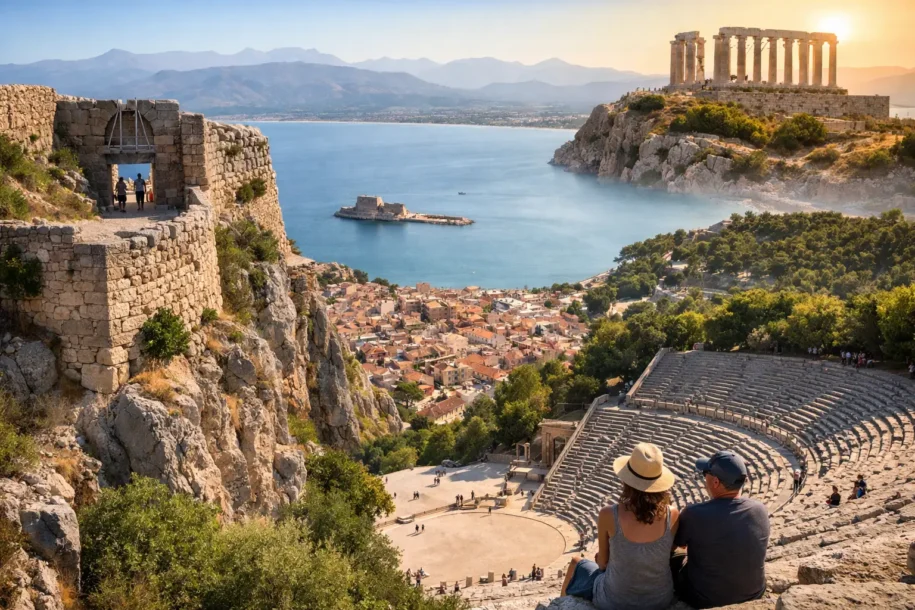
The pleasure of staying on the Argolic Gulf is that a day can begin beside an infinity pool and end beneath the stones of a Bronze Age citadel. The finest cultural attractions near Nafplio are not tucked into one museum district or limited to a single era. They range from Mycenaean kingdoms and classical theaters to Venetian fortresses, graceful old-town streets, and intimate archaeological sites overlooking the sea.
For travelers who appreciate beautiful settings as much as meaningful experiences, Nafplio is an exceptional base. The most rewarding visits are unhurried: a late-morning walk through an ancient site, a long lunch in a village square, then a return to the coast as the light softens over the water.
Cultural Attractions Near Nafplio for a Richer Stay
The Argolis region carries its history lightly but generously. Major landmarks are close enough for comfortable day trips, while smaller sites provide the kind of quiet, atmospheric moments that can become the most memorable part of a Greek holiday. A private car is particularly appealing for couples and families who prefer to set their own pace, though several destinations are also easy to reach by taxi or organized excursion.
1. Ancient Mycenae
Mycenae remains the essential excursion for anyone drawn to the scale and mystery of ancient Greece. Around a 30-minute drive from Nafplio, this UNESCO World Heritage site was once the center of a powerful Bronze Age civilization, and its monumental presence still feels remarkable. Walk through the Lion Gate, stand within the fortified citadel, and look across the dry, dramatic hills that shaped the world associated with Agamemnon.
The Treasury of Atreus, just beyond the main archaeological area, deserves time of its own. Its enormous beehive-shaped tomb creates a powerful sense of engineering ambition and ritual. Mycenae is best visited early or later in the afternoon, especially in summer, when the open landscape can be intensely warm and the views are at their clearest.
2. The Ancient Theater of Epidaurus
Epidaurus is one of those rare places where history feels almost theatrical before a performance even begins. Set amid pine-covered hills roughly 40 minutes from Nafplio, its ancient theater is celebrated for its extraordinary acoustics, elegant proportions, and remarkable state of preservation.
If your travel dates coincide with a summer performance, an evening at Epidaurus can be a highlight of an Argolis itinerary. Tickets and transport should be arranged well ahead for popular dates. Outside performance season, the theater still rewards a daytime visit, particularly when paired with the nearby Sanctuary of Asklepios, an important healing center of the ancient world. Allow several hours rather than rushing through it.
3. Tiryns and Its Cyclopean Walls
Tiryns is smaller and often quieter than Mycenae, yet it offers an equally compelling connection to the Bronze Age. Only a short drive from Nafplio, the site is known for its vast Cyclopean walls, built from stones so immense that later Greeks believed only mythical giants could have placed them.
This is an especially good choice for guests who want an archaeological experience without committing a full day to it. The citadel’s elevated position gives a clear view over the Argolic plain, while its covered passages and massive fortifications reveal a different side of Mycenaean life. Combine Tiryns with a leisurely lunch in Nafplio or an afternoon swim in Tolo.
4. Palamidi Fortress
Rising above Nafplio, Palamidi is both a cultural landmark and a spectacular vantage point. This Venetian fortress was completed in the early 18th century and later played a prominent role in Greece’s struggle for independence. Its bastions, stone corridors, and wide views make the visit feel more immersive than a conventional museum stop.
The famous stair climb is rewarding for active visitors, but it is not the only way to arrive. Driving or taking a taxi to the entrance is the more comfortable option in warm weather, particularly for families or anyone saving their energy for a full day of sightseeing. Go late in the day for softer light over the town, Bourtzi, and the gulf.
5. Nafplio Old Town and Its Museums
Nafplio’s old town is a cultural experience in itself. Venetian balconies, neoclassical facades, small squares, and bougainvillea-framed lanes create an elegant setting for an unplanned afternoon. Start around Syntagma Square, where the town’s layers of Ottoman, Venetian, and modern Greek history come into view.
The Archaeological Museum of Nafplio is a worthwhile stop for context before visiting Mycenae or Tiryns. Its collections span prehistoric Argolis through later periods, helping bring the region’s exceptional archaeological landscape into focus. The Komboloi Museum, devoted to Greek worry beads and their craft, offers a smaller, more unusual cultural interlude. It is ideal for travelers who enjoy design, material culture, and a thoughtful souvenir beyond the expected.
6. Ancient Asine Above Tolo
For guests staying near Tolo, Ancient Asine is one of the most beautifully placed sites in the area. The remains occupy a headland between the beaches of Tolo and Kastraki, with traces of settlement stretching from prehistoric times through the Byzantine era. The setting is modest compared with Mycenae, but that is part of its appeal.
Come for a quiet walk among ancient walls with the sea immediately below. Ancient Asine pairs naturally with a relaxed beach morning or sunset aperitif, and it offers a sense of discovery without the crowds of the region’s headline sites. Comfortable shoes are useful, as the ground can be uneven.
7. Ancient Argos
Argos is often overlooked, which makes it an appealing choice for travelers who want to step beyond the most familiar route. One of the oldest continuously inhabited cities in Europe, it lies about 20 minutes from Nafplio and has an ancient theater of striking scale, Roman remains, and a strong archaeological identity.
The theater is particularly impressive because it feels integrated into the living city rather than isolated from it. A visit here works well for those who have already seen Epidaurus and want a more intimate, less formal archaeological stop. Add the Archaeological Museum of Argos if you are interested in the longer story of the Argolic plain.
8. Bourtzi Castle
Floating just off Nafplio’s waterfront, Bourtzi is impossible to miss and even more captivating when seen up close. The small Venetian sea fortress was built in the 15th century to protect the harbor and has served many roles over the centuries, including fortress, prison, and residence.
Boat access and visiting arrangements can vary by season and conditions, so it is wise to confirm availability locally rather than building an entire day around an interior visit. Even from the promenade, Bourtzi is one of Nafplio’s defining cultural images. A sunset stroll along the harbor, with Palamidi lit above the town and Bourtzi reflected in the water, is simple but unforgettable.
How to Plan a More Elegant Cultural Itinerary
The most satisfying cultural days in Argolis balance grandeur with breathing room. Mycenae and Epidaurus are best treated as separate excursions if you want time for a leisurely lunch, photography, and a relaxed return to the villa. They can be combined in one ambitious day, but doing so often turns two extraordinary places into a checklist, particularly in the heat of summer.
For a gentler rhythm, pair one major site with one coastal or town experience. Visit Tiryns before lunch in Nafplio, explore Palamidi in the late afternoon, or spend a beach morning in Tolo before walking Ancient Asine. Guests traveling with children may find this approach more enjoyable, while history enthusiasts may prefer a full archaeological day with a private guide.
Spring and early fall offer the most comfortable conditions for outdoor monuments, though summer has the advantage of Epidaurus festival performances and long, luminous evenings. Carry water, wear shoes with grip, and bring a light layer for fortress visits after sunset. Above all, leave space in the schedule for the pleasures between the landmarks: a shaded terrace, a glass of local wine, and the changing blue of the Argolic Gulf.
From the privacy and panoramic beauty of Panoramic Villa, these cultural treasures feel close enough to enjoy with ease, while the return home still feels like the most luxurious part of the day.